
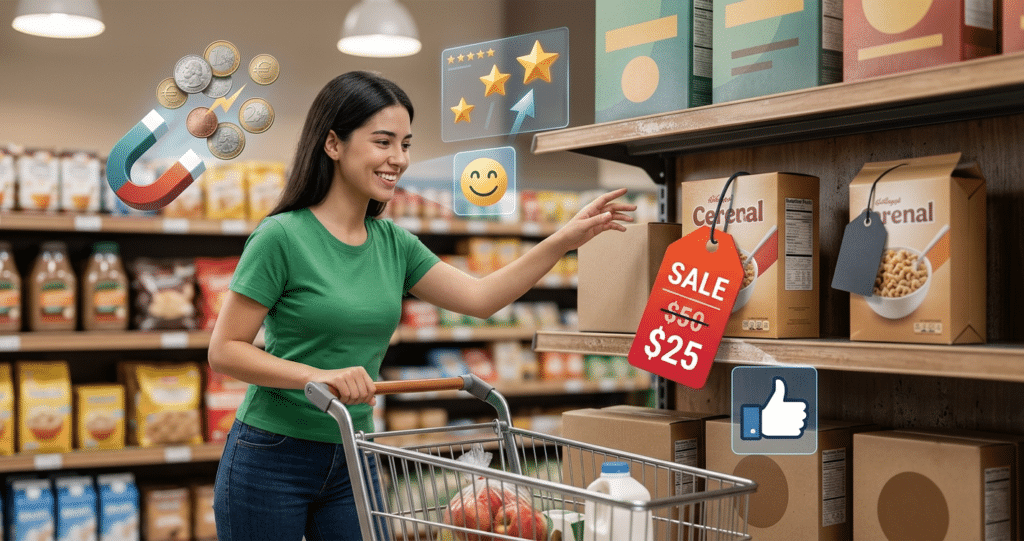
An item worth $24 suddenly drops to $18. Although you have no plans to buy it, the price drop catches your eye and makes you stop scrolling. Retailers want these little moments to happen more often.
Discounts can alter shoppers’ value perceptions while also affecting perceptions of urgency and need. Much of the debate revolves around whether discounts can influence consumers to change their mind or switch brands, or whether they simply select the brand or product that offers the discount.
According to an article on price discounts and consumer behaviour, discounts grab shoppers’ attention and sometimes drive them to buy products. Learn when discounts enhance purchase intention and when they cause shoppers to hold back.
Why a Discount Can Make a Product Feel More Valuable
People seldom evaluate a price by itself. When making a purchase, buyers will usually compare it to something else. They will have in mind the original price. Or, they will compare it to a competitor’s price. Finally, they will compare it with what they thought they would pay.
A jacket priced at $48 is marked down to $34. Even without checking whether $34 is a fair price, the crossed-out $48 makes it look like a good deal. The item now feels more like a saving than a $34 purchase.
Studies on price presentation indicate that the framing of savings can shape the perceived size of the discount by customers.
That’s why merchants don’t just present the final price. Along with this, they often display the original price, discount percentage, or savings.
How Discounts Influence Buying Decisions
The attention relates to the price discount given on the product. A sale badge, coupon, or even a “20% off” message can help a product stand out from dozens of other products that look the same.
The discount can shift the consumer’s question once the shopper notices the offer. They could flip the question around and ask themselves, “Is this a good opportunity?” instead.
Think of someone buying a backpack with a budget of $30. They find a bag originally priced at $42 for just $29. Seeing the higher-priced bag on sale might make it feel like a better deal.
Just because there may be a discount does not mean that all promotions lead to the same processing. Research indicates that while discount magnitude matters, it also depends on the timing and shopping context, which varies through the online journey.
Percentage Off vs. Money Saved
All else equal, “25% off” and “save $18” can communicate the same promotion. However, one may feel more attractive than the other.
For a low-priced product, the percentage may create the illusion of a larger saving. For a more expensive product, the amount saved may feel more relevant. According to research, perception of discount type could differ based on product price and category.
A 10% discount on an appliance costing $12 saves you $1.20. If a laptop costs $600, a 10% discount saves you $60. The percentage is the same, but the emotional response is quite different.
One reason discounts influence buying decisions is that it depends on more than just the percentage.
Discounts Can Trigger Unplanned Purchases
When a shopper walks into a store looking for one item and walks out with three, two of which are on sale.
A buy-one-get-one offer is a classic example. Although the shopper only needs one shirt, it would be sensible to buy one more due to the promotion. Online offers discount a product after you pay the minimum spending specified.
Research on multi-item promotions show that different approaches to framing products affects consumers choices of their choice and how much they want to spend on extras.
Discounts and their effect on purchase intention can be complex. While the promotion may improve purchase intention, it may also increase the shopping basket size.
A Small Discount Is Not Always Enough
Bigger Discounts Don’t Necessarily Create More Interest. At times, small savings can feel totally pointless.
Suppose a $6 product is reduced to $5.90. You are technically saving $0.10. But if it is not something you really need, saving 10 cents may not be enough to change your mind.
Interestingly, researchers have found that for certain cheap and useless products, small discounts can backfire and lead to fewer sales. The discount might cause the deal to appear less valuable than expected.
Retailers need to keep shoppers’ perceptions of a meaningful saving in mind and not market any reduction as a promotion.
Product Quality Still Matters
When a low price point is very low, it often begs the question, “Why so cheap?”
A new brand with a premium-looking product at an unusually low price may entice shoppers to check out the offering. However, some may also doubt the quality of this product. Research shows that negative quality perceptions can weaken the positive effect of discount framing.
Imagine two very similar headphones. One is from an unknown seller and costs $11, while the other is from a more trusted seller and costs $36. Although the lower price may catch your attention, you will likely start checking reviews, warranty, and seller ratings before buying.
When a shopper trusts a product or retailer, they are most likely to believe that a discount reflects the true price.
Why Shoppers Sometimes Stop Comparing Prices
When a shopper sees a discount, they feel they’ve hit a good deal already. That could lessen the incentive to continue looking.
Research on consumer search behavior shows that framing a price in terms of a discount leads people to search less, even when the underlying price comparison problem hasn’t changed.
We witness it easily when we go shopping. When you notice that a phone has a “30% off” label, you feel content with the price. However, another retailer may have the identical model for less, minus the dramatic discount sticker.
Consumers should note that the price after discount is the one that truly matters.
Discounts Work Best When They Feel Relevant
When a discount aligns with the customer’s existing desire, it is more persuasive.
Someone who has recently started exercising could benefit from a 20% discount on running shoes. Someone who has many already may attach little meaning to the same offer.
The differentiation is important, as discounts and purchase intention depend on personal needs. Gaining customer interest can happen through promotions, but relevance gives them a reason to act.
For businesses, sometimes a targeted offer can be more useful than just offering a bigger discount to everyone.
The Real Value Behind the Discount
A markdown alters the value of anything beyond just the price tag. It can affect the value perception, urgency, quality, and appeal of an offer to shoppers.
For shoppers, it’s best to take a step back and ask themselves one simple question: If the word “sale” were not present, would I still want this product at this price?
If it’s beneficial, the discount may be a legitimate chance. If not, that’s a mere promotion to make you buy something you never needed.
FAQs
What effect do price discounts have on consumers?
By promising greater value through discounts, attention is drawn away with customers in which they make faster decisions. In many cases, customers tend to buy more than they originally planned to due to discounts. The product, discount size, framing, need, and consumer effect dependence are found.
Are discounts increasing purchase intention?
No. A weak or poorly presented discount won’t have much power. If the price is unusually low for a quality product, then the customer may suspect dirt-cheap quality. Unrelated discounts will not change the shopper’s degree of decision-making.
What makes discounts affect purchasing choices?
Discounts can help in making a product seem more valuable by creating a reference price. They can also instil urgency and make shoppers feel like they can get a better deal.
Is a percentage discount more favorable than a fixed amount discount?
Neither option is better. The format that is more persuasive can depend on the price of the product and how big the saving feels. When a product is very expensive, the actual saving amount can be more meaningful.
Can discounts encourage people to spend more?
Certainly. Promotions like multi-item discounts, coupons, and spending thresholds can lead shoppers to add products they weren’t going to buy initially.